
One of the most remarkable travelers on Earth, and one of the fastest disappearing. Here is the monarch's story, and how South Jersey can help write the next chapter.
No single monarch makes the round trip. The generation that leaves Mexico each spring is the great-great-grandparent of the one that returns the following fall. South Jersey sits directly on their Atlantic flyway.
A monarch is not born a butterfly. It is rebuilt from the ground up through four distinct stages, a process called complete metamorphosis, and the whole transformation takes about a month.
A female lays 100 to 300 eggs over her lifetime, each one placed on a milkweed leaf and nowhere else. They hatch in about four days.
It hatches smaller than a grain of rice and grows to about two inches in under two weeks, shedding its skin five times along the way just to keep up.
Inside the jade-green chrysalis, the caterpillar is taken apart and rebuilt as a butterfly. Its emergence even has a name of its own: eclosion.
A summer monarch lives just a few weeks. But the generation that emerges in fall lives about eight months, long enough to fly to Mexico and back north in spring.
Asclepias syriaca, incarnata, and tuberosa
A monarch will drink nectar from hundreds of flowers, but she can lay her eggs on one family of plants and no other.
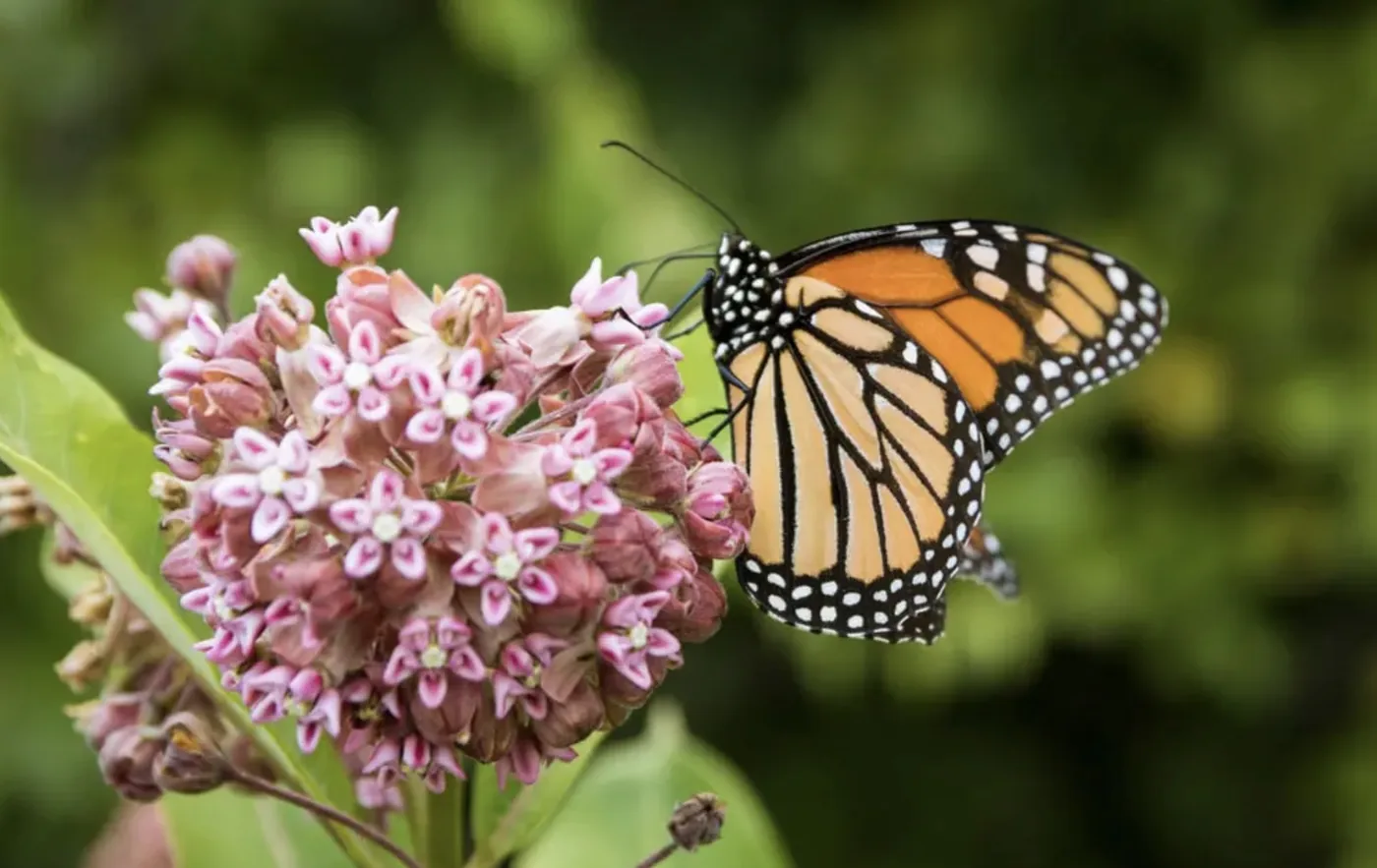
Female monarchs lay their eggs only on milkweed. When the caterpillars hatch, milkweed is the only thing they will eat. The plant's bitter sap makes both the caterpillar and the adult butterfly toxic to most predators, which is why a monarch can wear its bold orange warning colors out in the open.
No milkweed means no eggs, no caterpillars, and no next generation. Across the Midwest farm landscape, roughly 58 percent of milkweed disappeared between 1999 and 2010, sprayed off fields as herbicide-tolerant crops spread. Monarch production there fell about 81 percent over the same period. That loss is the single biggest reason monarch numbers have collapsed.
The fix is refreshingly direct. Three milkweeds are native to New Jersey and grow easily here: common milkweed, swamp milkweed, and the orange-flowered butterfly weed. Plant any of them and you have built a monarch nursery.
| Eggs laid per female | 100 to 300 |
| Egg to butterfly | About 30 days |
| NJ native milkweeds | Common, swamp, butterfly weed |
| Midwest milkweed lost, 1999-2010 | ~58% |
Goldenrod, asters, coneflower, joe-pye weed
Caterpillars need milkweed. The butterfly itself runs on nectar, and the timing of the blooms matters as much as the flowers.
The caterpillar's diet is one plant. The butterfly's is the opposite. An adult monarch drinks nectar from whatever is blooming, moving flower to flower all day to get enough sugar to keep flying.
For the fall generation, nectar is more than a meal. The monarchs leaving New Jersey in September have to build fat reserves that carry them the whole way south and then sustain them through the winter, because once they settle into the Mexican mountains they eat almost nothing until spring.
The trip north runs on the same fuel. Early spring wildflowers power the overwintering generation out of Mexico, and it takes three or four more generations, each raised on milkweed and fed on nectar, to finish the journey their great-grandparents started.
| Spring, heading north | Early wildflowers |
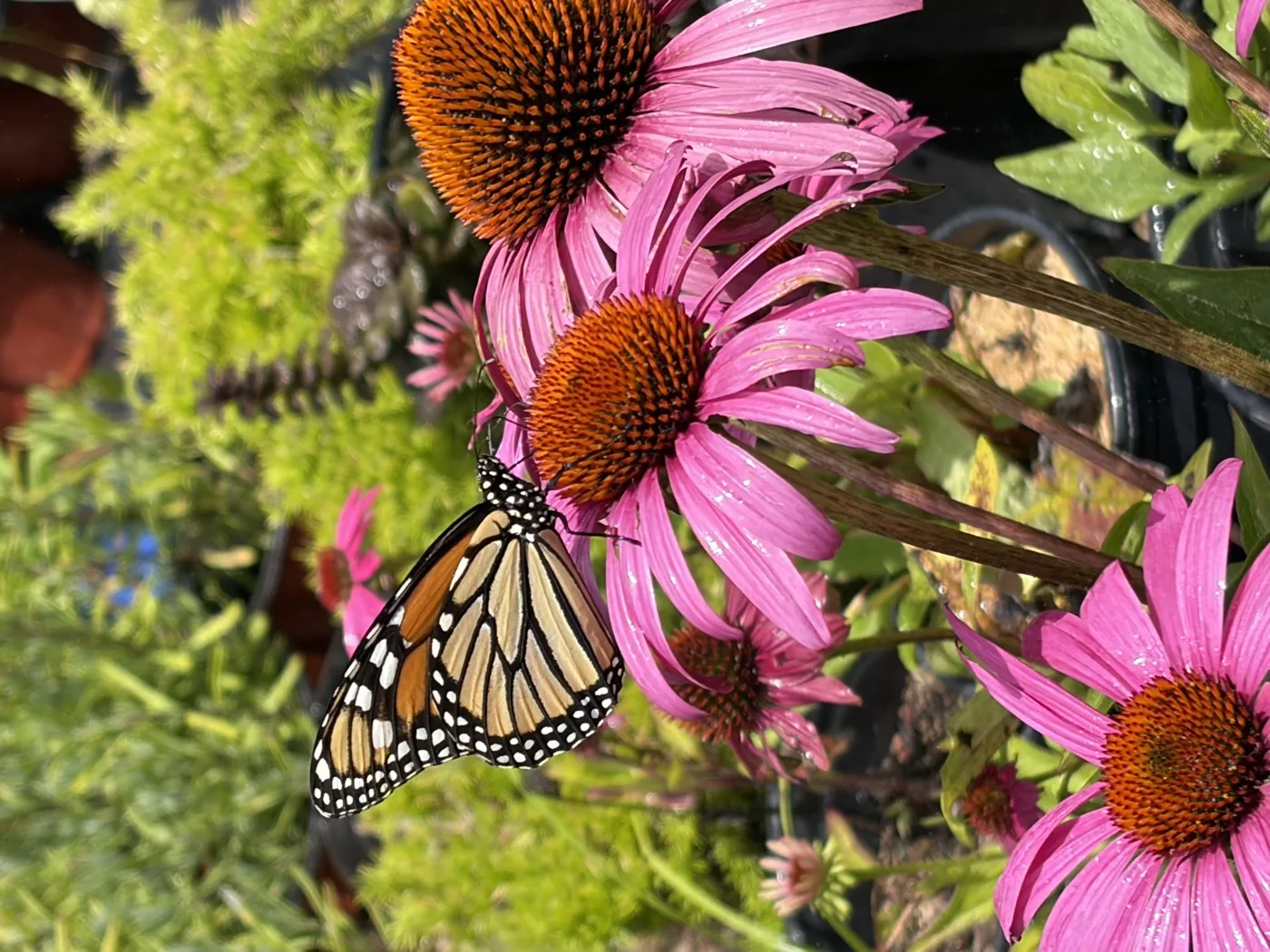
| Summer, breeding here | Coneflower, bee balm, milkweed bloom |
| Fall, heading south | Goldenrod, asters, joe-pye weed |
| Winter, in Mexico | Almost nothing. Stored fat |
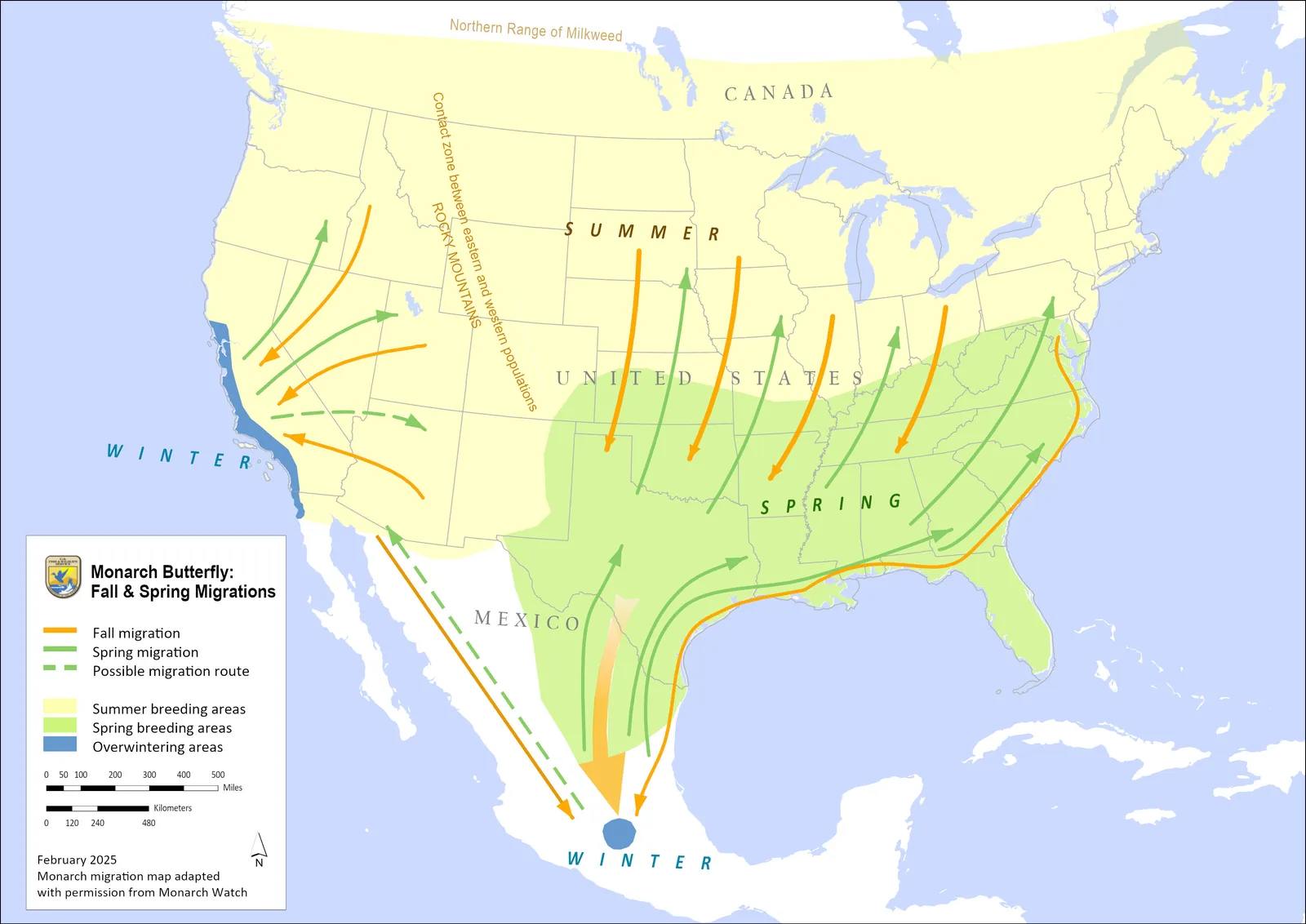
Two populations make two very different trips. East of the Rockies, monarchs winter in the mountains of central Mexico. West of them, they winter in groves along the California coast. The map below shows both: fall routes in orange, spring in green.
Summer range to the oyamel firs of central Mexico
Nearly every monarch east of the Rockies, from Canada to the Gulf, funnels down to the same few mountainsides.
Monarchs travel by day and roost by night, gathering in trees and shrubs that hold a little warmth and break the wind. The route works like stepping stones: patch after patch of late-blooming nectar, each one a place to refuel. Lose too many stepping stones, and the map stops working.
The winter home is a band of oyamel fir forest up to about two miles above sea level, where the air stays between roughly 32 and 59 degrees. Cool enough to keep the butterflies still, never so cold it kills them, and humid enough that they do not dry out. They hang there in their millions, living off stored fat, until March sends them north again.
New Jersey sits right on the Atlantic leg of that map. Each fall, monarchs stream down our coastline and gather at Cape May before crossing the Delaware Bay. What we plant here fuels a journey that ends two thousand miles away.
| Winter home | Oyamel fir forests, central Mexico |
| Elevation | Up to about 2 miles |
| Winter temperature | 32 to 59 °F |
| Heads north | March |
Overwintering groves along the California coast
The smaller western population never crosses into Mexico. It winters within sight of the Pacific.
Western monarchs spend the winter clustered in coastal groves of eucalyptus, Monterey cypress, and Monterey pine, sometimes packed so densely the branches bend under them. Between February and March they scatter inland, hunting for milkweed to lay the next generation on. Those groves keep giving way to coastal development, which is a big part of why this population has fallen so hard.
And not every monarch migrates at all. Small resident populations live year-round in places like the San Francisco Bay Area and South Florida, usually where non-native tropical milkweed blooms through the winter. Year-round breeding lets diseases build up in ways the migration would normally leave behind. It is one more reason we plant only the milkweeds that belong here.
| Winters in | California coastal groves |
| Roost trees | Eucalyptus, cypress, pine |
| Heads inland | February to March |
| Resident colonies | Bay Area, South Florida |
In 2022 the migratory monarch was added to the IUCN Red List as endangered, and reassessed to vulnerable in December 2023. The eastern population that passes through New Jersey has fallen by more than 80 percent since the 1990s. The western population has dropped by more than 99 percent since the 1980s.
Herbicide-tolerant crops let growers spray fields end to end, erasing the milkweed that once grew between the rows and along every field edge.
New Jersey is one of the most developed states in the country. The meadows and roadside wildflowers that fed migrating monarchs keep giving way to lawns and pavement.
Nearly the entire eastern population crowds into a few mountain forests in Mexico each winter. Illegal logging there puts the whole migration at risk in one place.
Drought, heat, and storms along the route, plus blooms that open too early or too late, throw off the timing the migration depends on.
Common lawn and garden insecticides kill caterpillars outright and linger in plant tissue, turning would-be habitat into a hazard.
The journey south runs on nectar. Every lost patch of late-blooming goldenrod and aster is a fuel stop erased from the map.
Three countries share this butterfly, and all three now treat it as a species in trouble. Protection looks different in each one.
In December 2024 the U.S. Fish and Wildlife Service proposed listing the monarch as threatened under the Endangered Species Act. A year later the Service pushed the final decision back, and a ruling is not expected before late 2026. In the meantime, states including California, Illinois, Iowa, Minnesota, and Texas carry protections of their own, and in those states handling or raising monarchs can require a permit.
Canada listed the monarch as endangered under its Species at Risk Act in December 2023. On federal lands there, it is illegal to kill, harm, or capture a monarch at any stage of its life, egg to adult.
Mexico holds the monarch under special protection, and the mountain forests where the entire eastern population spends the winter sit inside the Monarch Butterfly Biosphere Reserve, a UNESCO World Heritage Site.
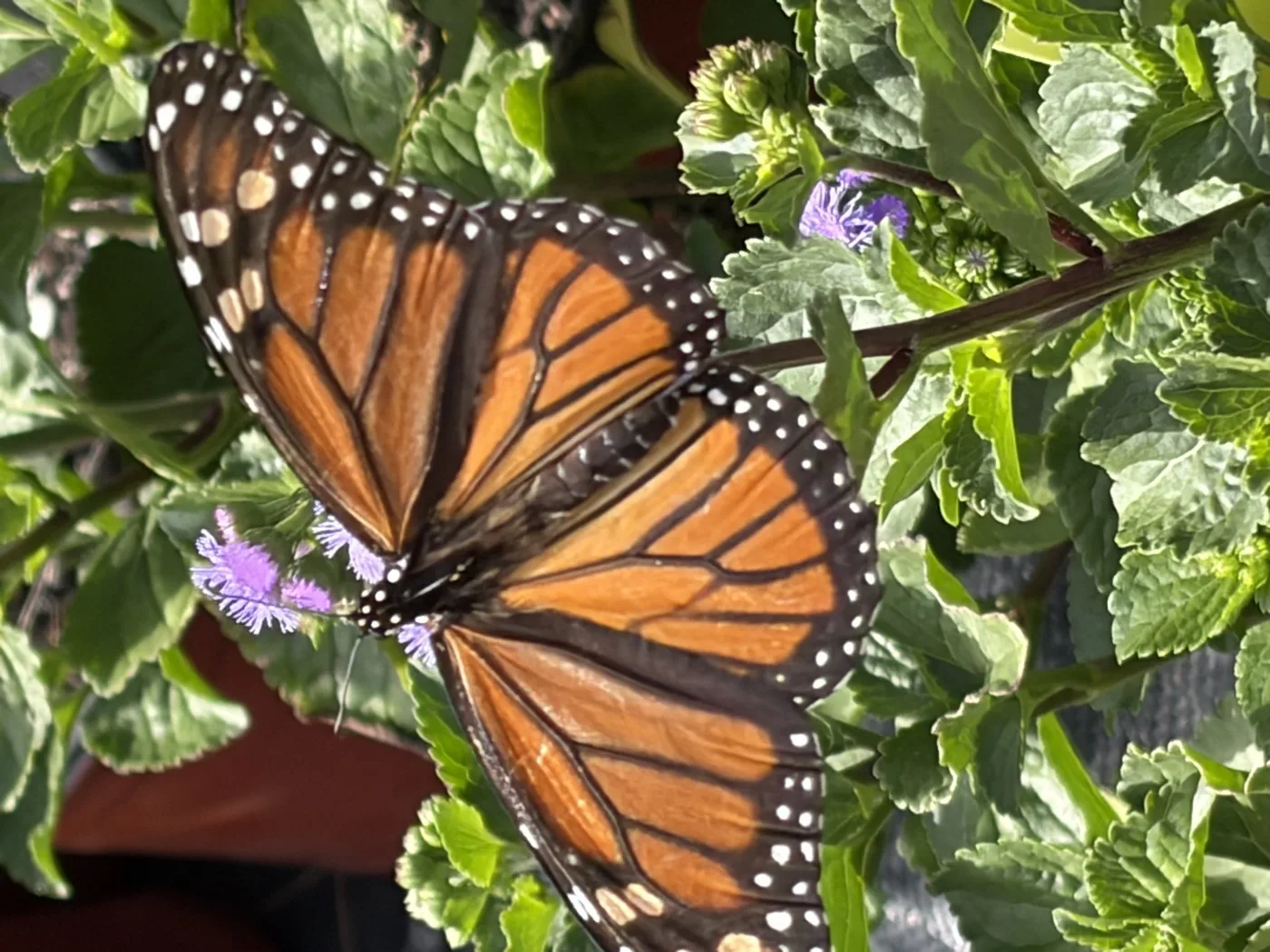
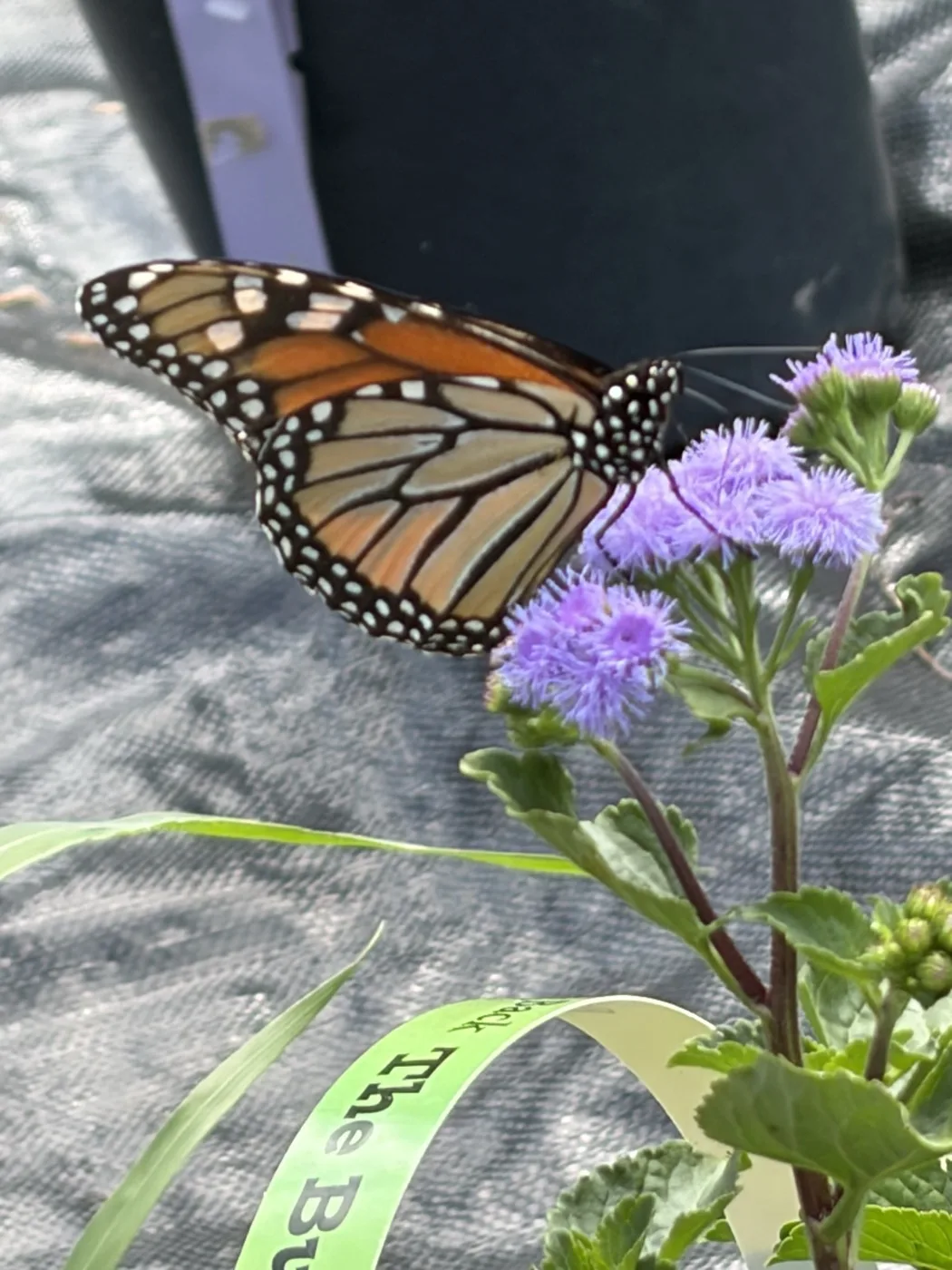
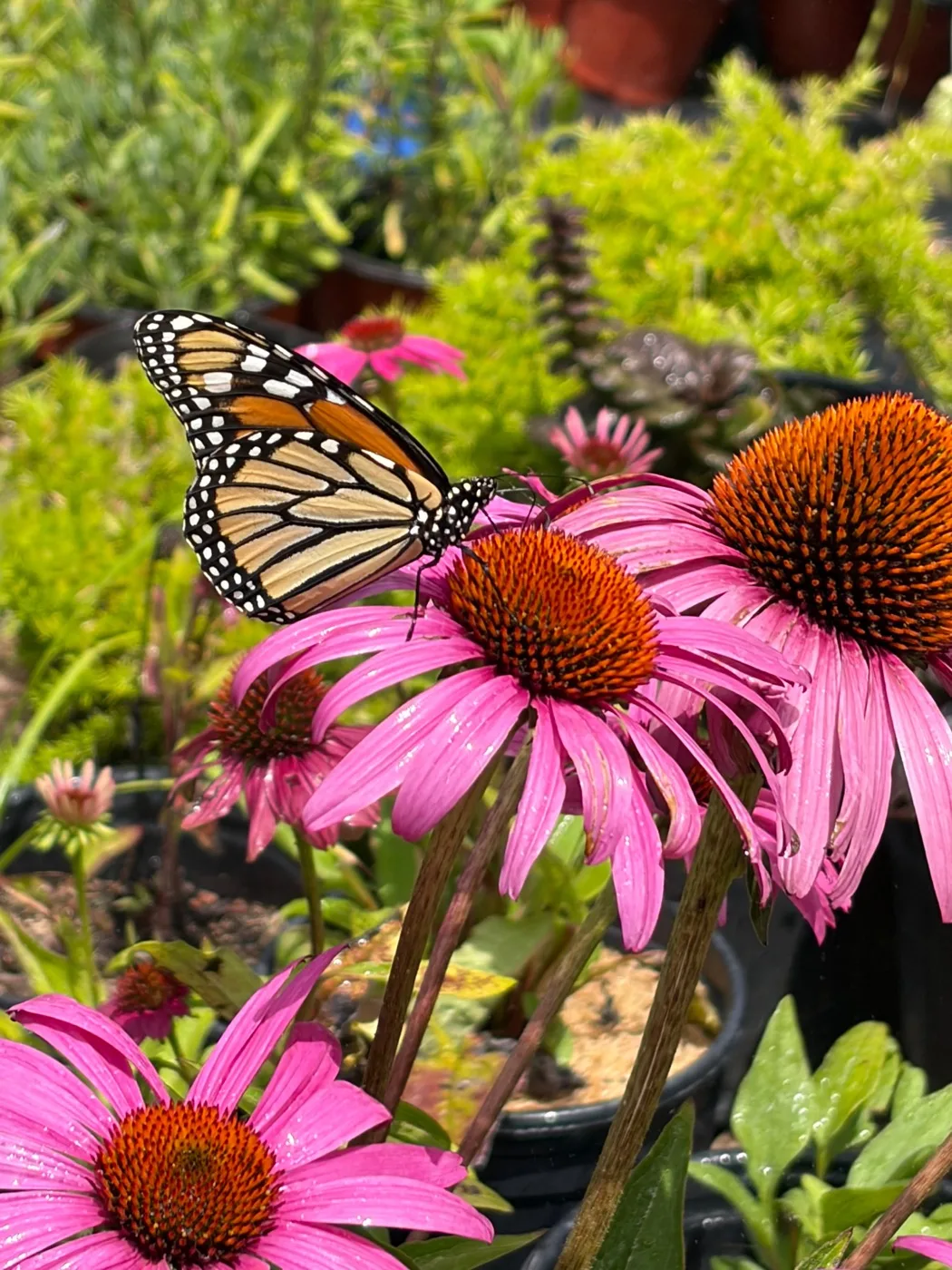
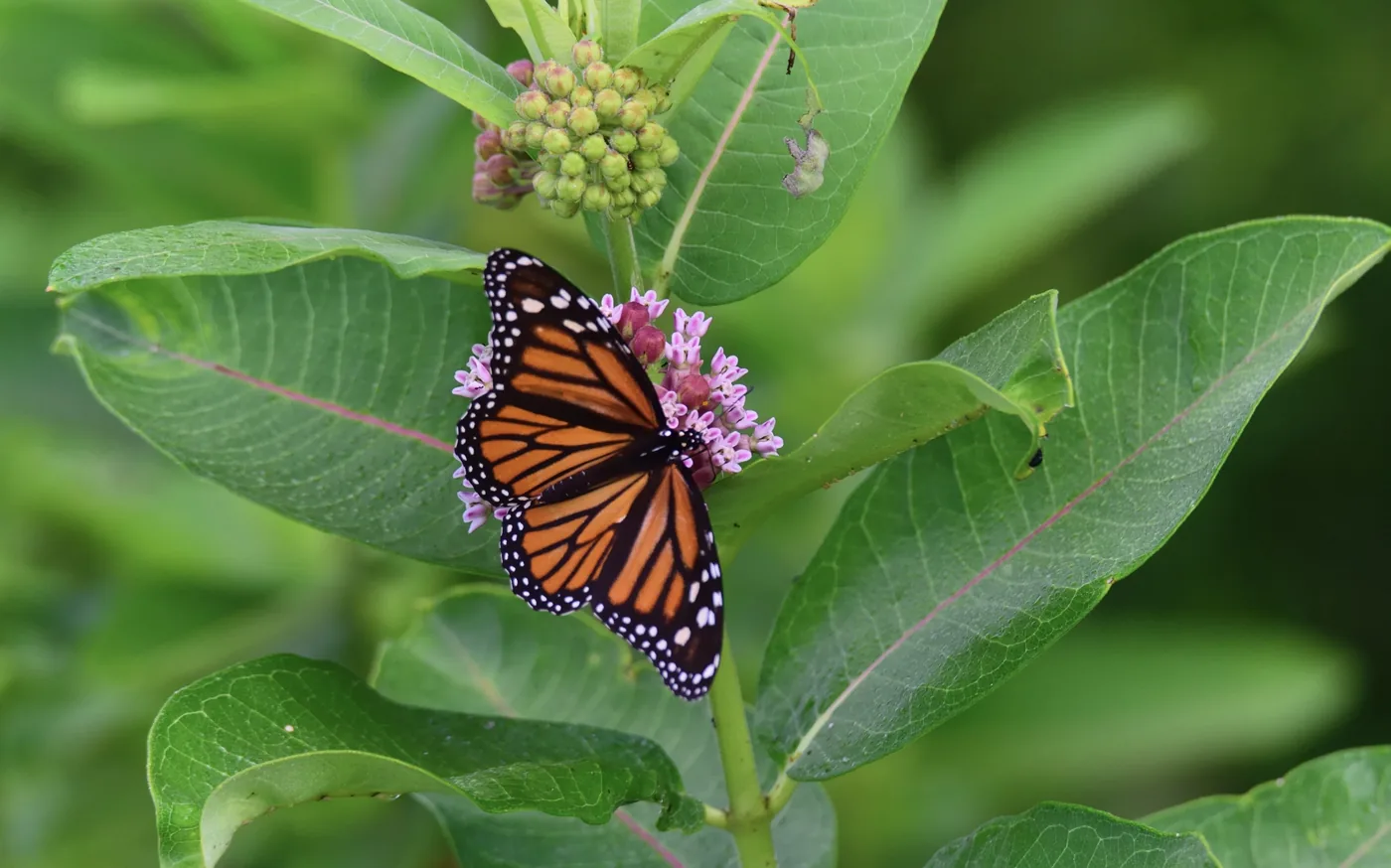
Every one of these was photographed in a Grasso Pollinator Alliance planting. Build the habitat, and they come.
Monarch recovery is one of the few conservation problems an ordinary backyard can genuinely move. And if you farm, manage land, or run a schoolyard, you can move it at scale. Here is where to start.
Every plant on this chart grows in South Jersey. The milkweeds raise the caterpillars; everything else keeps the butterflies fed from the first spring arrivals to the last stragglers heading south in October.
| Plant | Blooms | What it does |
|---|---|---|
| Common milkweedAsclepias syriaca | June to August | Host + nectar. The classic monarch nursery |
| Swamp milkweedAsclepias incarnata | July to August | Host + nectar. Happiest in damp ground |
| Butterfly weedAsclepias tuberosa | June to August | Host + nectar. Bright orange, takes dry sun |
| Purple coneflowerEchinacea purpurea | June to September | Summer nectar staple |
| Wild bergamotMonarda fistulosa | June to September | Summer nectar |
| Joe-pye weedEutrochium species | July to September | Tall late-summer nectar |
| Blue mistflowerConoclinium coelestinum | August to October | Late nectar, the flower in our photo above |
| New England asterSymphyotrichum novae-angliae | August to October | Fall migration fuel |
| GoldenrodSolidago species | August to October | Fall migration fuel |
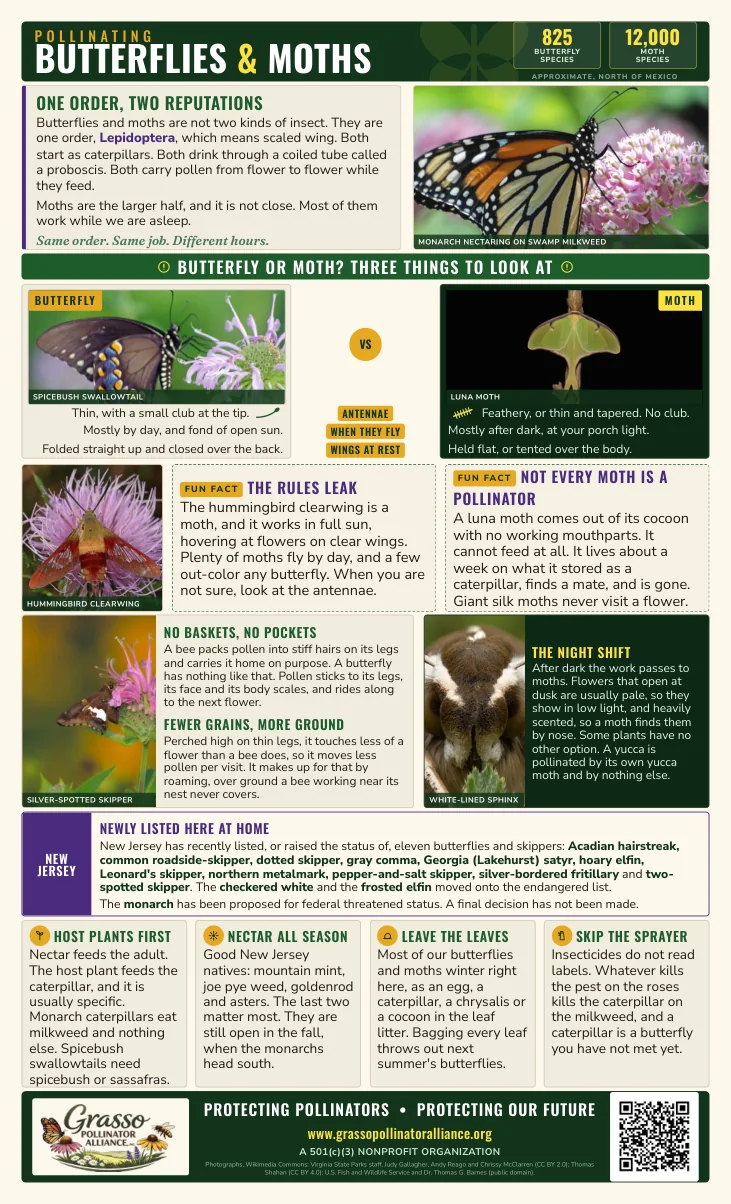
The butterflies and moths sheet, and the summer and fall bloom guide that keeps nectar on the table through the monarch migration. Tap a poster to view it full size, or download the PDF.

Every milkweed plant we put in the ground is a place for the next generation to begin. Help us plant more.
Donate Now